
AI and Automation in Primary Research Execution: How Research Teams Can Move Faster Without Losing Rigour?


Primary research is becoming more efficient, more scalable, and more insight-rich as AI and workflow automation move deeper into execution. Leading consulting firms increasingly position AI not as a replacement for researchers, but as a force multiplier that reduces manual effort in drafting, coordination, transcription, synthesis, and workflow management while preserving human judgment where it matters most.
For firms that run interview-led studies, survey programs, expert consultations, or multi-market research projects, the opportunity is clear: use AI to remove repetitive execution friction so research teams can spend more time on respondent quality, question design, analysis, and client-facing interpretation.
Why this matters now
McKinsey estimates that generative AI can automate work activities that absorb 60 to 70 per cent of employees’ time today, especially in language-heavy knowledge work, and identifies customer operations, marketing and sales, software engineering, and R&D as functions with significant value potential.
That matters directly for primary research because the execution layer is full of language-based tasks such as screener design, outreach drafting, interview note synthesis, and first-cut summary creation.
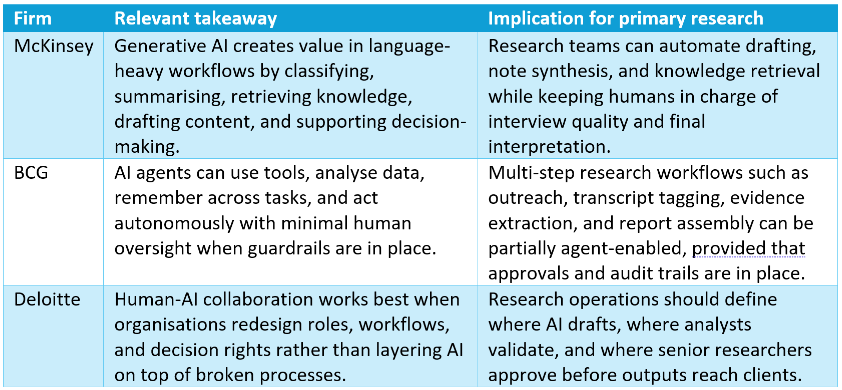
McKinsey also notes that knowledge workers have historically spent a significant share of time searching for and gathering information, while BCG argues that AI agents can analyse data, plan tasks, take action, and collaborate with humans across real workflows.
Deloitte adds that organisations that intentionally redesign roles, workflows, and decision-making around human-AI collaboration are more likely to exceed expectations on returns and meaningful work outcomes.
Where AI can improve primary research execution
The strongest use cases sit in the operational middle of the research lifecycle rather than at the final interpretation stage. AI and automation can compress timelines, improve consistency, and help teams manage larger volumes of research without linear increases in headcount.

What leading consulting firms suggest
A common theme across major consulting perspectives is that the highest value does not come from dropping AI into old processes unchanged. It comes from redesigning workflows so that AI handles repetitive actions, people handle judgment-intensive tasks, and governance sits across both layers. The table below translates those perspectives into the context of primary research.
Practical examples in research delivery
Consider a market-entry study requiring 25 expert interviews across three countries. AI can help draft a first-pass discussion guide from the project brief, produce localised outreach sequences, automate scheduling reminders, transcribe interviews, and cluster recurring themes by geography or respondent type before an analyst begins synthesis.
The outcome is not automated insight in isolation; it is a faster path to an analyst-reviewed evidence base.
A second example is a B2B buyer behaviour study based on mixed methods. Survey platforms can automate fielding and response capture, transcription tools can process open-ended follow-up interviews, and qualitative analysis tools can generate early pattern maps that help researchers compare stated needs, buying triggers, and objections across respondent groups.
This reduces turnaround time and makes it easier to run more iterations within the same delivery window.
Useful AI tools for primary research teams
The best tool stack depends on the research design, security requirements, and the degree of workflow standardisation. In practice, most teams will combine a general-purpose generative AI assistant, a transcription layer, a survey platform, and an automation tool.

Guardrails that matter
The more research teams automate, the more important governance becomes. BCG emphasises controls such as clear ownership, role-based permissions, risk tiering, logging, explainability, and human intervention points when deploying AI agents in business workflows.
Those principles apply directly to primary research, especially where confidential client material, respondent data, or regulated industries are involved.
At a minimum, firms should define which tasks AI may draft, which actions require analyst validation, what data can be exposed to external tools, and how outputs are checked before client delivery. Human review remains essential for question quality, respondent relevance, inference validity, and the final articulation of findings.
Operating model for research firms
A practical way to think about AI in primary research is as a three-layer model: human-led design, AI-assisted execution, and human-approved insight delivery. This structure preserves rigour while still capturing speed and scale benefits from automation.

The most effective implementation model is not full automation; it is selective automation of repetitive tasks paired with disciplined researcher oversight, which supports faster delivery, more consistent documentation, and greater capacity to run multi-market or interview-heavy studies.
Used well, AI can make primary research execution more responsive and more scalable. The competitive advantage will belong to teams that combine automation with methodological discipline, human judgment, and a workflow design that treats AI as an execution partner rather than a substitute for insight.


Comments