
Integration of AI and IoT in renewables: A Strategic Imperative for the Energy Transition

Updated: Sep 7, 2025
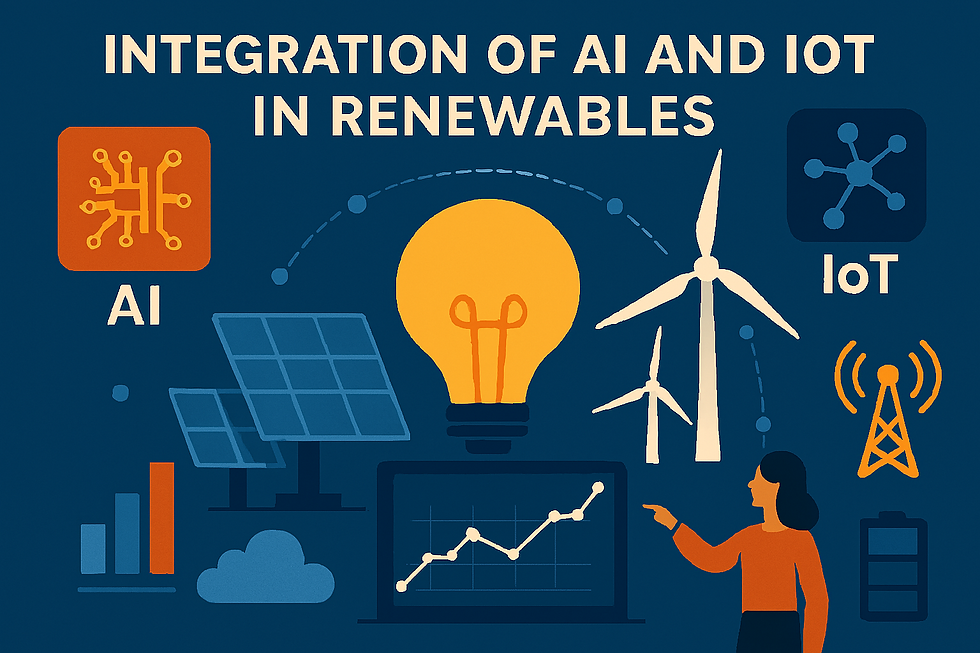
The global energy landscape is undergoing a seismic shift. As nations race to decarbonize their economies and meet ambitious climate targets, renewable energy sources—solar, wind, hydro, and geothermal—have emerged as the cornerstone of sustainable development. Yet, their intermittent nature and decentralized generation pose significant challenges to grid stability, forecasting, and operational efficiency.
Enter Artificial Intelligence (AI) and the Internet of Things (IoT), two transformative technologies that, when integrated, offer unprecedented opportunities to optimize, automate, and scale renewable energy systems. This article explores how AI and IoT are reshaping the renewables sector, the key benefits and challenges, and strategic recommendations for stakeholders.
⚙️ The Synergy of AI and IoT in Energy Systems
AI and IoT are complementary forces:
IoT provides real-time data from sensors, smart meters, weather stations, and energy assets.
AI processes this data to generate actionable insights, predictions, and autonomous decisions.
Together, they enable a smart, adaptive, and resilient energy ecosystem.
Key Applications
Application Area | Role of AI & IoT |
Energy Forecasting | AI models predict solar/wind output using weather data from IoT sensors |
Smart Grid Optimization | AI algorithms balance supply-demand; IoT enables real-time grid monitoring |
Predictive Maintenance | AI detects anomalies; IoT sensors monitor equipment health |
Load Management | AI forecasts consumption patterns; IoT tracks usage across devices |
Distributed Energy Resources | AI coordinates microgrids; IoT connects rooftop solar, EVs, and batteries |
🌞 Case Study: Solar Energy Forecasting with AI
A photovoltaic plant in India implemented a neural network-based AI model to forecast solar output. By ingesting granular weather data from IoT-connected sensors, the system achieved a prediction accuracy of over 90%, outperforming traditional statistical methods. This enabled better grid planning, reduced reliance on fossil fuel backups, and improved energy dispatch efficiency.
📈 Business Benefits
1. Operational Efficiency
AI-driven automation reduces manual intervention, while IoT ensures real-time visibility. This leads to faster fault detection, optimized asset performance, and reduced downtime.
2. Cost Reduction
Predictive maintenance minimizes repair costs and extends asset life. Smart forecasting reduces energy wastage and curtails overproduction.
3. Grid Resilience
AI enhances grid stability by dynamically adjusting energy flows. IoT enables decentralized control, crucial for integrating variable renewables.
4. Sustainability Metrics
AI models track carbon savings, energy intensity, and ESG compliance. IoT devices provide granular data for sustainability reporting.
🧠 AI Techniques in Renewables
Technique | Use Case in Renewables |
Machine Learning | Forecasting energy generation and consumption |
Deep Learning | Modeling complex weather-energy relationships |
Reinforcement Learning | Optimizing grid operations and energy trading strategies |
Natural Language Processing | Analyzing maintenance logs and customer feedback |
🌐 IoT Architecture in Renewable Systems
A robust IoT framework includes:
Edge Devices: Smart meters, inverters, weather sensors
Communication Protocols: LoRaWAN, Zigbee, 5G
Cloud Platforms: Azure IoT Hub, AWS IoT Core
Analytics Engines: AI models for forecasting, diagnostics, and optimization
Security, scalability, and interoperability are critical design considerations.
🚧 Challenges and Risks
Despite the promise, integration is not without hurdles:
Data Quality: AI models require high-resolution, clean data. Poor sensor calibration or missing data can degrade performance.
Cybersecurity: IoT devices are susceptible to various types of attacks. Secure protocols and encryption are essential.
Infrastructure Compatibility: Legacy grid systems may not support real-time data exchange or AI integration.
High Initial Costs: AI and IoT deployments require significant capital investment in hardware, software, and training.
🧭 Strategic Recommendations
For energy companies, utilities, and policymakers, here’s a roadmap to successful integration:
1. Start with Pilot Projects
Test AI-IoT solutions in controlled environments, e.g., a solar farm or microgrid, before scaling.
2. Invest in Data Infrastructure
Ensure robust data pipelines, cloud storage, and analytics platforms. Data governance is key.
3. Collaborate Across Ecosystems
Partner with tech firms, academia, and startups. Innovation thrives in cross-disciplinary teams.
4. Focus on Cybersecurity
Implement multi-layered security protocols, regular audits, and AI-based threat detection.
5. Upskill the Workforce
Train engineers and operators in AI, data science, and IoT protocols. Human-AI collaboration is vital.
🔮 The Future Outlook
As AI models become more sophisticated and IoT devices more ubiquitous, the renewables sector will evolve into a self-optimizing, intelligent energy network. Emerging trends include:
Digital Twins: Virtual replicas of energy assets for simulation and optimization
AI-Driven Energy Markets: Autonomous trading based on real-time forecasts
Blockchain Integration: Secure, decentralized energy transactions
Edge AI: On-device intelligence for faster decision-making
📝 Conclusion
The integration of AI and IoT in renewable energy is not just a technological upgrade—it’s a strategic imperative for a sustainable future. By harnessing data, intelligence, and automation, stakeholders can unlock new efficiencies, reduce emissions, and build resilient energy systems that power the world responsibly.
For organizations ready to lead the energy transition, the time to invest in AI-IoT synergy is now.


...thats interesting.