
How Will Autonomous Fleets Reshape Performance in High-Velocity Industries?

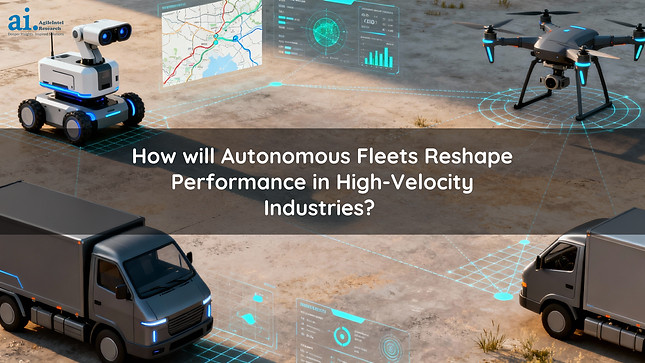
Are global supply chains prepared for a future where machines coordinate, decide, and move goods with near-zero human intervention?
The answer is no, not yet, but the pace of adoption shows that the shift is no longer theoretical. Autonomous mobility has evolved far beyond cars and consumer robotics, now unfolding within structured, high-intensity industrial environments where precision, uptime, and predictability directly define competitive advantage.
A 2024 McKinsey survey reported that more than 70% of industrial executives believe autonomous mobility will become one of the strongest drivers of operational efficiency by 2030. The World Economic Forum adds that automated material handling systems can increase throughput by up to 30% in complex logistics hubs. Together, these indicators demonstrate that autonomy is transitioning from experimental technology to core operating infrastructure, establishing new performance benchmarks that traditional systems cannot meet.
The industrial economy is entering a stage where coordinated autonomy will determine which enterprises run at peak efficiency and which fall behind.
The Industrial Fleet Inflection Point
Autonomous industrial fleets represent a fundamental redesign of how materials circulate through factories, ports, warehouses, and extraction sites. This shift is not a simple extension of automation. It signifies a new operating model powered by networks of intelligent machines that move with precision, synchronise in real time, and function continuously without fatigue or operational drift.
Warehouses have demonstrated how quickly scale can be achieved once autonomy becomes economically viable. Global utilisation has risen sharply as companies pursue higher throughput and more consistent performance. Ports have followed similar trajectories by deploying automated vehicles that streamline container flow and shorten turnaround times. Mining operators have reported significant productivity improvements from fleets of autonomous haul trucks that run around the clock without the constraints of human scheduling.
These outcomes confirm that the sector has passed an adoption threshold. Autonomous fleets are no longer experimental assets. They are establishing themselves as essential components of industrial performance.
Why Industrial Players Are Accelerating Adoption
The drivers behind the rapid expansion of autonomous fleets reflect real operational pressures rather than interest in emerging technology for its own sake. Each factor signals a shift in how enterprises define resilience and efficiency.
Predictability in an Unstable Supply Environment
As disruptions intensify and supply chains grow more complex, enterprises are prioritising systems that support uninterrupted movement. Autonomous fleets reduce dependency on labour variability and maintain flow stability even when external conditions become unpredictable. This establishes a foundation for more reliable service levels and improved long-term planning.
Structural Cost Reductions
Companies adopting autonomous fleets are realising meaningful reductions in operating costs through continuous utilisation, lower error rates, optimised routes, and improved asset efficiency. In sectors with narrow margins, the ability to compress cost per movement becomes a compelling competitive lever.
Safer and More Compliant Operations
Material handling tasks carry inherent operational risks. Autonomous fleets significantly reduce exposure to hazardous conditions and support stronger compliance cultures. The resulting improvement in workforce safety and regulatory alignment strengthens organisational resilience.
Enhanced Operational Intelligence
One of the most underestimated advantages of autonomous fleets is the data they generate. Every movement, stop, deviation, and interaction becomes structured intelligence that feeds predictive maintenance models, informs layout redesigns, and strengthens digital twin simulations. This data-centric approach elevates operational decision-making and improves long-term optimisation.
These drivers reinforce one another, making autonomy more valuable with each stage of maturity.
The Emerging Architecture of Autonomous Fleet Ecosystems
The rapid evolution of autonomous fleets is reshaping not only factory floors but also the digital and operational architecture required to support them.
Integrated Fleet Coordination Platforms
Enterprises are shifting toward advanced coordination platforms that manage thousands of autonomous assets across sites. These platforms optimise routing, prevent congestion, balance utilisation, and ensure that fleets behave as a unified system rather than isolated machines.
Edge First Decision Intelligence
The rise in on-device processing has enabled fleets to make high-speed decisions locally. Reduced latency improves safety, enhances path optimisation, and allows fleets to function effectively in environments where connectivity is inconsistent or constrained. This trend strengthens the reliability of autonomy at a scale.
Interoperability as a Strategic Requirement
As fleets diversify across vendors and asset types, interoperability is moving from a technical preference to a core strategic requirement. Enterprises that prioritise open, standards-aligned architectures are better equipped to scale autonomy without escalating integration costs or being limited by proprietary systems.
This emerging architecture marks a significant shift in the field. Autonomous fleets are evolving into distributed intelligent systems that require coordinated digital infrastructure to unlock their full potential.
The Competitive Advantage Shift
Autonomous fleets are reshaping the competitive landscape across various industrial sectors. Early adopters are already achieving performance levels that are difficult for traditional operators to match.
The most significant advantage lies in speed. Fleets that operate continuously and optimise themselves dynamically compress cycle times, elevate throughput, and create service reliability that competitors struggle to replicate. At the same time, data-rich operations strengthen forecasting, network planning, and asset management.
Capital efficiency also improves as enterprises optimise fleet utilisation, restructure workflows, and adopt shared or mixed autonomy models. This reduces cost per output unit and establishes a more resilient operating baseline.
The coming decade will draw a clear line between organisations that operate with coordinated autonomy and those that remain limited by manual movement.
Conclusion
The autonomous industrial fleet revolution is advancing faster than many anticipated and is fundamentally reshaping industrial performance. As autonomy becomes core infrastructure, enterprises that move early will secure significant operational and strategic advantages.
AgileIntel believes the organisations that lead in the next decade will be those that recognise autonomy as the new backbone of industrial capability. Autonomous fleets are revolutionising how industries operate, make decisions, and compete. They are becoming the operational core of intelligent, resilient, and high-velocity enterprises.


Comments