
How Will Autonomous Enterprises Redefine Competitive Advantage in the 2030 Economy

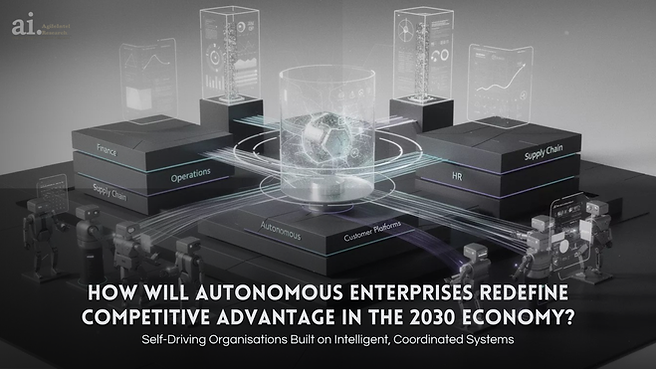
The last decade pushed enterprises to digitise fast. The current decade is forcing them to think even bigger. What began as workflow automation and AI augmentation is rapidly evolving into something fundamentally different: enterprises that can operate independently of their IT infrastructure.
Across industries, AI-driven systems, autonomous agents, advanced analytics, robotics, and digital twins are converging into a cohesive operating model. The emerging reality is not just more automation. It is autonomy, where decision-making, execution, optimisation, and correction become largely machine-driven, with humans elevated to higher-order judgement, design, and oversight.
Forward-looking organisations are no longer asking whether to adopt autonomy. They are asking how quickly they can modernise their operating model to capture its compounding advantages.
Why Autonomous Enterprises Are Emerging Now
Autonomy is the product of multiple structural forces that mature simultaneously. Each force is reshaping how enterprises must operate and compete.
A. Enterprise Complexity Has Outpaced Human Capacity
Global supply chains, real-time transactions, connected assets, regulatory workloads, and cybersecurity risks have expanded significantly. The operational surface area of a modern enterprise can no longer be manually monitored or controlled. Autonomy has become a foundational requirement for maintaining stability at scale.
B. Real-Time Expectations Are Redefining Value
Enterprises are now judged by their ability to anticipate disruptions, self-correct in milliseconds, and deliver uninterrupted services. Markets reward intelligence, precision, and speed. Autonomous systems excel in these realities, especially where operational predictability meets high-volume variability.
C. The Economics of Autonomy Are Strengthening
The global Autonomous Mobile Robot (AMR) market reflects the shift toward intelligent, robotics-supported operations. It was valued at US$2.53 billion in 2021, reached US$3.09 billion in 2022, and is projected to reach US$9.74 billion by 2029. This growth signals a clear enterprise-wide pivot toward autonomous infrastructure in logistics, retail, automotive, and industrial value chains.
D. A Transforming Workforce Model
Skill shortages, rising labour costs, and the need for 24/7 reliability are forcing organisations to reassess workforce design. Autonomy frees human talent from repetitive tasks and directs people toward high-impact work that requires human judgment and creativity.
Modern enterprises increasingly require intelligence at machine scale rather than human scale. Autonomy delivers that capability.
The Autonomous Core: AI-Native Operating Models
Autonomous enterprises differ fundamentally from traditional automated environments. Automation handles tasks. Autonomy manages whole outcomes.
How AI-Native Operations Function
Autonomous agents govern workflows from initiation to completion.
Processes self-optimise in real time based on dynamic data signals.
Orchestration engines execute decisions independently, guided by enterprise policies.
Context-aware systems continuously detect anomalies, correct deviations, and recalibrate.
Digital twins simulate operational choices and predict outcomes before actions are taken, enabling informed decision-making.
This shifts the organisation from a process-centric mindset to a system-centric approach. Instead of teams running operations, operations begin running themselves.
Real-Time Self-Correction: The Backbone of Autonomy
Self-correction is one of the defining capabilities of autonomous enterprises. Reactive operating models cannot match the pace or precision of predictive and real-time systems.
Examples include:
IT infrastructure redistributing workloads before latency thresholds are crossed.
Manufacturing machinery adjusts speed, temperature, or torque to avoid defects.
Supply chains rerouting shipments proactively based on multi-variable disruption indicators.
Risk engines are adjusting fraud or credit thresholds in milliseconds to match behavioural patterns.
The enterprise moves from diagnosis and response to prediction and prevention. This materially reduces downtime, strengthens resilience, and ensures operational continuity.
Decision Intelligence at Enterprise Scale
Decision intelligence forms the cognitive engine of the autonomous enterprise. It goes beyond traditional BI or analytics dashboards and becomes a real-time decision layer embedded across all operations.
Autonomous decision systems are designed to:
Ingest multimodal and high-frequency data across operations, markets, assets, and customer touchpoints.
Process real-time signals that would be impossible for human teams to monitor continuously.
Simulate scenarios at scale using advanced and generative models to identify and mitigate operational blind spots.
Optimise choices across interdependent constraints, balancing cost, throughput, risk, and service-level requirements.
Trigger downstream actions autonomously, ensuring instant and consistent execution in accordance with enterprise policy.
This unified intelligence layer enables precision across:
Real-time pricing and revenue optimisation
Dynamic routing and resource deployment
Predictive and proactive maintenance
Multi-echelon inventory optimisation
Fraud and risk assessment with adaptive thresholds
Production sequencing that balances cost, demand, and energy efficiency
Decision-making shifts from periodic, human-led coordination to continuous, AI-enabled optimisation. Humans remain in control, but they are no longer directly involved in the critical path of every decision.
Human Work Elevated: The New Talent Architecture
Autonomy transforms the nature of human work. It does not eliminate the need for people. It elevates their contribution. People move into zones where human judgment has disproportionate value. These include:
Enterprise design and transformation
Oversight of complex AI systems
Customer innovation and experience architecture
High-stakes negotiation
Ethical decision-making
Creative problem solving
Strategic scenario planning
Early adopters find that human productivity increases because repetitive operational tasks no longer constrain talent. Instead, they focus on shaping strategy, driving innovation, and strengthening customer value.
Industry Examples: Autonomy in Action
Autonomy is no longer experimental. Industry leaders across various sectors have already integrated autonomous capabilities into their mission-critical operations. Their deployments illustrate how autonomy scales, how quickly it begins delivering value, and how deeply it transforms core operational systems.
The following examples provide a cross-industry perspective on what autonomy looks like when fully operational and strategically aligned.
Amazon operates one of the largest autonomous fulfilment ecosystems in the world. More than 750,000 robots collaborate with human associates in a coordinated system that continuously optimises pick paths, safety zones, and throughput. Autonomy allows Amazon to manage extreme demand variability and improve unit economics while expanding its global fulfilment footprint.
JPMorgan Chase utilises autonomous fraud engines that analyse billions of micro-signals in real-time. The system reduces false positives by 30%, shortens investigation cycles, and adapts continuously to emerging fraud patterns. This strengthens risk protection and improves customer experience without increasing operational load.
Siemens integrates digital twins into its advanced factories, allowing continuous simulation of production outcomes. The environment automatically identifies optimal schedules, resource mixes, and energy configurations. Productivity improves by 20 to 25%, while human intervention is required only for exceptions or design improvements.
Tesla's adaptive manufacturing cells detect micro-defects through perception systems and adjust calibration instantly. This reduces rework and stabilises quality across rapid production cycles. The autonomous adjustments allow Tesla to scale aggressive manufacturing targets while maintaining precision.
Walmart's deployment of autonomous storage and retrieval systems enables high-speed pallet construction and rapid sequencing across distribution centres. These systems improve throughput reliability, reduce cycle times, and strengthen in-store availability for high-demand categories.
DHL Supply Chain utilises fleets of AMRs and autonomous pallet movers to optimise warehouse operations. Travel time decreases significantly, manual handling is reduced, and human associates transition into roles focused on quality checks, exception management, and customer-specific requirements.
Mercedes-Benz Factory 56 showcases advanced automotive autonomy. Autonomous guided vehicles move vehicle bodies, digital systems coordinate sequencing, and real-time analytics adjust production based on demand shifts. Multiple models are produced on the same line with minimal downtime or reconfiguration effort.
Risks and Governance: A Strategic Imperative
As autonomy scales, governance becomes essential.
Key priorities include:
Ensuring autonomous decisions remain auditable and explainable
Establishing criteria for human override
Strengthening cybersecurity for expanded autonomous environments
Monitoring ethical considerations such as fairness and transparency
Building readiness for evolving regulatory frameworks
Governance determines whether autonomy strengthens the enterprise or exposes it to new vulnerabilities. The strongest organisations invest in governance and independence simultaneously.
Market Momentum: The Economics of Autonomy
The market signals around autonomy are powerful indicators of global transformation.
A. Capital Investments Are Increasing
Enterprises are redirecting capital from traditional automation to autonomy-enabling platforms that combine robotics, AI, data orchestration, and edge processing.
B. Ecosystem Collaboration Is Expanding
Technology providers, hyperscalers, robotics innovators, and data infrastructure companies are aligning their roadmaps. This lowers deployment complexity, accelerates integration, and amplifies enterprise value.
C. Enterprise Impact Is Clearly Measurable
Organisations adopting autonomous capabilities consistently report:
Double-digit productivity uplift in warehouses and manufacturing
Reduced variance in quality output
Higher forecasting and planning accuracy
Shorter cycle times in logistics and retail
Lower downtime across IT and production assets
Autonomy is no longer theoretical. It consistently demonstrates material value across industries.
Micro Case Studies: Deeper Insight into Real-World Outcomes
While large-scale transformations highlight the strategic value of autonomy, micro case studies reveal its precision-level impact. These examples demonstrate how autonomy enhances specific operational levers, including cost, accuracy, forecasting, routing, and inventory management outcomes. Each illustrates how even a single autonomous capability can produce measurable enterprise value.
UPS uses predictive route optimisation that incorporates traffic, density, historical delivery patterns, and real-time data. Saving more than 10 million gallons of fuel is only one dimension. The system also improves delivery precision, enhances customer reliability, and reduces operational waste.
Unilever's forecasting system integrates internal and external data, including weather shifts, local events, and buyer behaviour. The 30% improvement in forecast accuracy reduces lost sales, strengthens retailer partnerships, and improves planning reliability across fast-moving categories.
H&M's AI-driven redistribution model evaluates demand volatility and store-level patterns. The 15% reduction in overstock improves cash flow, reduces markdown dependency, and supports sustainability goals by lowering unsold inventory volumes.
Conclusion: Autonomy as the Defining Enterprise Advantage
The next decade will reward enterprises that rethink their operating model from the ground up. Autonomy is not a technology trend. It is a structural shift in how organisations create value, manage complexity, and scale performance. Enterprises that embed autonomous decisioning, predictive correction, AI-native workflows, and robotics-enabled operations will move faster, operate with greater precision, and achieve resilience that traditional models cannot replicate. These organisations will be better positioned to navigate volatility, respond to market pressures, and outperform in environments that demand continuous intelligence.
The journey to autonomy requires more than adopting advanced technologies. It demands new governance structures, redesigned human roles, integrated data foundations, and orchestration platforms that allow diverse autonomous capabilities to operate as a single system. This type of transformation is architectural, not incremental. Organisations that begin now will gain advantages that compound over time, while those that hesitate risk being overtaken by enterprises that can learn, adapt, and execute at machine speed.
In the 2010s, digital was the differentiator.
In the 2020s, AI became the accelerator.
By 2030, only autonomous enterprises will define the frontier.


Comments